
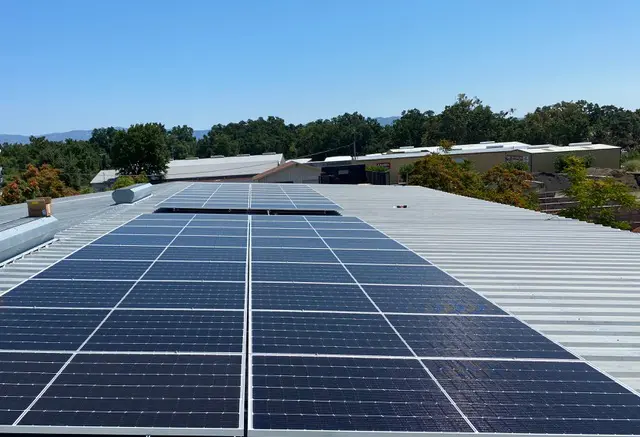
Most commercial solar proposals begin with a satellite photo of your roof. That is the wrong starting point. The roof tells you the maximum system you could build. It tells you nothing about the system you should build.
At Light Ray Electric we design to a different target: the portion of your electric bill that solar can actually retire, at a scale your business can actually absorb. That approach has a name internally — minimum to spec — and it produces smaller systems, lower invoices, and shorter paybacks than the roof-filling alternative.
This article explains the reasoning, because it runs against most of what businesses are told about solar.
Two Constraints Decide the Right Size
A commercial system that delivers its best financial return sits at the intersection of two limits. Exceed either one and the additional panels earn far less than the ones before them.
| Constraint | What It Governs | Why It Matters |
|---|---|---|
| On-site consumption | How much of what you generate your building uses the moment it is generated | Energy consumed on site is worth the full retail rate you would otherwise have paid. Energy exported to the utility is worth a fraction of it. |
| Tax and depreciation appetite | How much of the federal credit and first-year depreciation your business can actually claim | Incentives you cannot use do not reduce your net cost. A system sized past your appetite is bought at full price. |
Roof area is a third limit, but it is a ceiling rather than a target. It rarely binds before the other two do.
Why Daytime Businesses Are Different
Residential solar has a timing problem. A house is mostly empty when the sun is highest and busy after dark, so a home system exports heavily at midday and buys power back in the evening. That mismatch is why residential solar conversations turn so quickly to battery storage.
A commercial building does not have that problem. A restaurant kitchen, a refrigerated warehouse, a machine shop, an air-conditioned retail floor — these draw their heaviest load during precisely the hours a solar array produces its most. Production and consumption line up on their own.
That coincidence is the single most important fact in commercial solar design, and it is what makes a modest system so effective. When the array is sized to the building’s midday load, very nearly every kilowatt-hour it produces is consumed on site at full retail value. Nothing is sold back. Nothing needs to be stored.
Push past that point and the picture changes quickly. The next increment of capacity produces at the same midday hours — when the building’s demand is already met — so it has nowhere to go but the grid.
The Export Problem, Stated Plainly
Under California’s Net Billing Tariff, electricity exported to the utility is credited at avoided-cost values rather than at the retail rate you pay. Midday is when the grid is most oversupplied with solar, so midday exports are credited at some of the lowest values in the schedule.
This is the mechanism behind a phrase used throughout our site: by utilizing most or all of your solar production for your building’s needs, the Utility imposed 75% sell-back reduction is defeated.
We do not build systems whose returns depend on selling power back. Surplus is not a revenue stream to be optimized. It is a design error to be sized out.
The Second Constraint: What Your Business Can Absorb
The federal Investment Tax Credit and 100% bonus depreciation are central to how quickly a commercial system pays for itself. Both are claimed against tax liability, which means their value is capped by how much liability your business actually has.
A company that can fully use the incentives on a 60 kW system may be able to use only part of them on a 120 kW system. The second system costs twice as much and delivers materially less than twice the benefit.
This is why our proposals begin with a conversation about tax posture rather than square footage. You do not have to install your entire long-term vision this year. Many customers begin with a system matched to current appetite and expand later as the business grows.
Tax treatment depends on your specific circumstances. Consult your tax professional.
A Note on Demand Charges
Commercial electric bills generally carry two distinct kinds of charge: energy charges, billed on the kilowatt-hours you consume, and demand charges, billed on your highest instantaneous draw during the period.
Right-sized solar is very effective against energy charges. It is much less reliable against demand charges, because a single cloudy afternoon or a compressor starting at the wrong moment can set a monthly peak that the array happened not to be covering.
Reducing demand charges dependably is a storage problem, not a solar problem. It is a legitimate project — it is simply a different one, with different economics, and we treat it separately rather than folding an optimistic assumption about it into a solar proposal.
How the Approaches Compare
| Design Approach | Sizing Basis | Practical Result |
|---|---|---|
| Fill the roof | Available mounting area | Largest invoice. Substantial midday export at reduced credit. Incentive value may exceed what the business can claim. |
| Offset annual usage | Total annual kilowatt-hours | Made sense under retail-rate net metering. Under the Net Billing Tariff it over-builds for the hours that matter. |
| Minimum to spec | Midday on-site load, bounded by tax appetite | Smallest investment that captures the available savings. Nearly all production consumed on site. Expandable later. |
What This Means for Commercial Customers
The best system is not necessarily the largest one. In many cases a properly optimized 50 kW system can outperform a poorly matched 75 kW system — not because the smaller array saves more money in absolute terms, but because it earns a far better return on every dollar invested, and it leaves capital free for the rest of your business.
At Light Ray Electric we analyze utility bills and interval energy data before designing anything. We look at your operating schedule, your rate schedule, your electrical distribution, your major equipment, and your expansion plans. Only then do we size an array.
The result is a design focused on reducing operating costs — not simply maximizing installed capacity.
Our Design Philosophy
Every commercial project starts with the same question:
“How can we maximize the value of every kilowatt-hour your solar system produces?”
Most solar contractors begin by measuring your roof. We begin by measuring your electrical demand.
Request a free consultation to review your bills and find the size that fits your building.